Child-Focused Hearing Care and Assessment
A pediatric hearing clinic for children checks hearing, looks for possible hearing loss and guides families towards suitable support. Audiologists may use behavioural hearing assessment, otoacoustic emissions testing, BERA testing, ASSR testing and tympanometry. The choice depends on the child’s age, development and clinical needs. Hearing rehabilitation can support listening, speech and communication goals after assessment. Parents should seek advice when a child does not respond to sound, has delayed speech, gets repeated ear problems or struggles at school. A child-friendly clinic explains each step, adapts testing and gives clear follow-up advice.
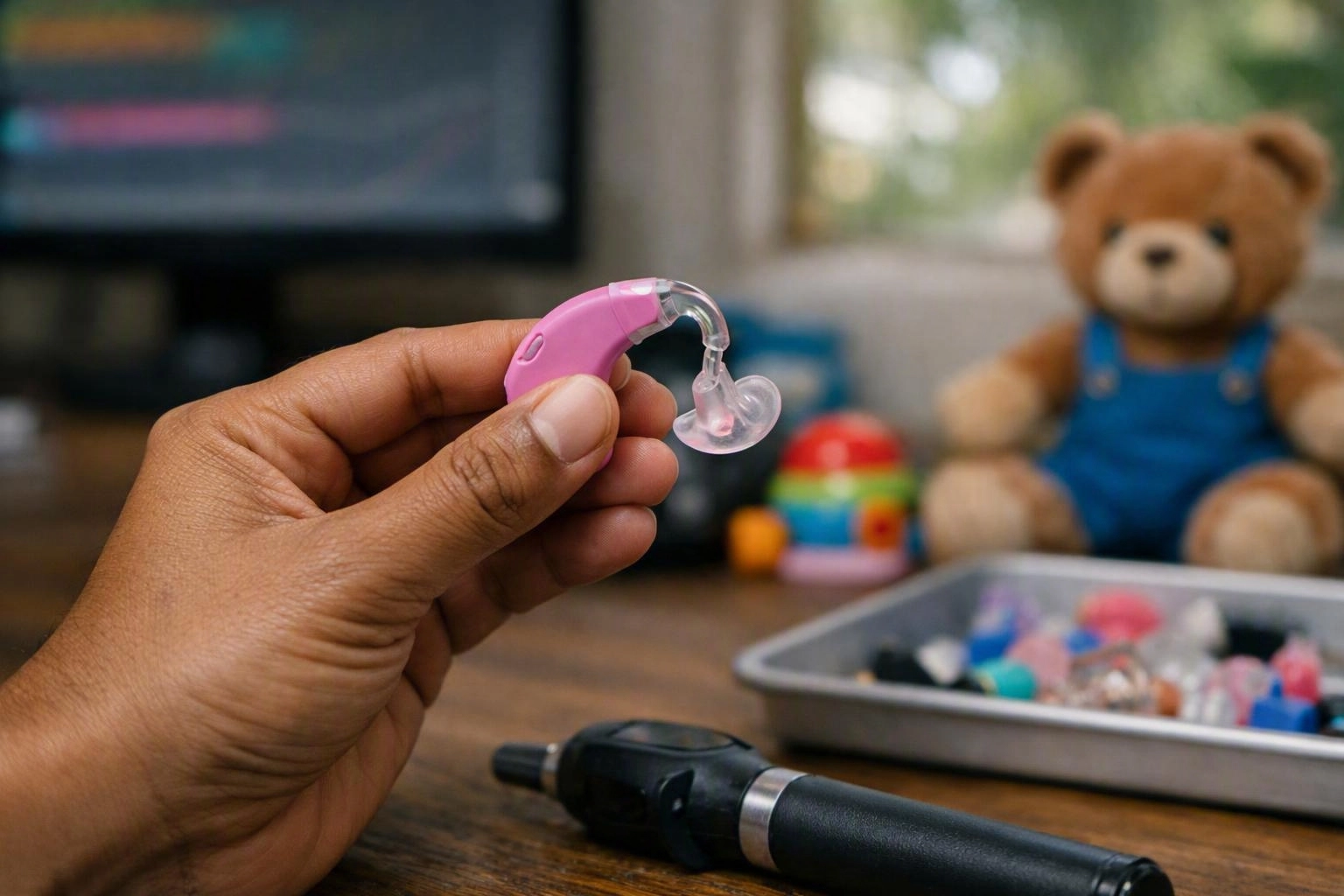
A pediatric hearing clinic for children offers age-appropriate hearing assessment and rehabilitation. It supports children and families concerned about hearing, listening, speech or communication. At Audium Hearing Aid Clinicwe explain the process clearly and adapt each appointment to the child.
Our team supports infants, toddlers and school-age children in a calm setting. Families can make an enquiry if they notice changes in listening, speech delay, language concerns or reduced responses to everyday sounds.
Why Children May Need a Hearing Assessment?
Childhood hearing assessment can find hearing loss, changing hearing and listening difficulties. These concerns may affect speech, language, learning or behaviour. Parents may seek assessment when a child responds unevenly to sound, has delayed communication, gets repeated ear infections or struggles to follow classroom speech.
Concerns can appear at any age. Parents needn’t wait for speech or learning problems to become serious before asking for advice. A timely referral may support early help when clinically suitable.
How a Pediatric Hearing Clinic Assesses Children?
A pediatric hearing clinic assesses children through a history review, ear examination and age-appropriate hearing tests. The audiologist chooses methods based on age, attention, communication and medical history. Results from several tests may be reviewed together.
A Pediatric audiologist starts with a case history. This may cover pregnancy, birth, milestones, responses to sound, ear infections, medicines, family history and the referral reason. Parents can describe what they notice at home or school.
Otoscopy lets the clinician look at the outer ear and eardrum. It can show visible blockage, wax, irritation or other findings that may affect testing. The clinician explains this gentle examination first.
For infants, an infant hearing assessment may use objective tests while the child is settled or asleep. Toddlers may respond through play, such as turning towards a sound or placing a toy. Older children may complete conditioned tasks or pure-tone audiometry.
Testing is adapted for attention, communication and sensory needs. The audiologist may use visual prompts, breaks, familiar words, headphones or insert earphones. A child may need another visit if tiredness, anxiety or uneven responses affect reliability.
Families considering Pediatric Hearing Assessment in Bhubaneswar can ask how the appointment will suit their child. Test selection depends on the clinical question, development and need for behavioural or objective measures. No specific result can be promised before assessment.
Otoacoustic Emissions Testing is an objective hearing test. It measures responses from cochlear outer hair cells. Other methods assess the auditory brainstem response or provide information for separate frequencies. The clinician reviews these findings with behaviour and medical history.
Which Hearing Tests May Be Recommended?
single test suits every child. The choice depends on age, development, cooperation and the clinical question. It also depends on whether reliable behavioural responses are possible.
| Test | What it assesses | How it may help |
|---|---|---|
| Otoacoustic Emissions Testing | Cochlear outer hair-cell responses | Provides an objective measure when a child cannot give steady behavioural responses. |
| BERA Testing | Auditory brainstem response to sound | Estimates hearing responses and checks activity along the auditory brainstem pathway. |
| ASSR Test | Frequency-specific objective hearing responses | May provide information across separate frequencies during objective testing. |
| Tympanometry | Middle-ear function | Checks eardrum movement and pressure patterns linked with fluid or other middle-ear concerns. |
| Pure-tone audiometry | Behavioural hearing thresholds | Measures the quietest sounds a child responds to at selected frequencies. |
Most appointments take about 30 to 90 minutes. The time depends on the child’s age, tests, breaks and need for repetition. The audiologist explains preparation, expected responses and possible follow-up.
Features and Challenges That Matter to Families
Families need a pediatric hearing service with child-friendly care, suitable testing and clear communication. Useful features include flexible methods, explained results and support for different needs. Children may have limited attention, fear equipment, give uneven responses, feel tired or need more than one visit.
Our team cares about the child’s comfort and the quality of the results. A calm appointment can help the clinician see more dependable responses without rushing the family.
Key Features for Families
Common Challenges for Children
These changes support infants, toddlers and school-age children. They also recognise that children respond in different ways. Families should share important developmental, medical and sensory details early.
Understanding Your Child’s Hearing Results
A child’s hearing results show how the outer, middle and inner ear respond to sound. They also show whether responses remain steady across frequencies. Tympanometry checks middle-ear function, while objective tests assess cochlear or auditory pathway responses. An audiologist reads these findings alongside development, behaviour and medical history.
Hearing thresholds show the quietest sound a child responds to during behavioural testing. They may differ between ears and pitches. Results are understood as a pattern, not one separate number.
Tympanometry gives information about the middle ear. It checks eardrum movement and pressure. A concern may suggest conductive hearing loss, which affects sound movement through the outer or middle ear. Medical review may be advised.
Objective testing can examine cochlear responses or the auditory nerve pathway. A pattern linked with sensorineural hearing loss involves the inner ear or related neural pathway. More assessment may be needed before confirming the cause or long-term plan.
Our team explains what is known and what remains uncertain. We also explain what should happen next. Families can ask for a written summary, home and school advice, and details about follow-up testing.
When Should Parents Arrange Follow-Up?
Follow-up depends on the results, referral reason and child’s development. Parents shouldn’t delay advice if concerns continue after a reassuring test.
- Review the findings: Ask what each result means and whether both ears gave reliable responses.
- Arrange a repeat hearing assessment: This may help when responses were uneven, hearing may change or the child was unwell.
- Consider referral to an ENT specialist: Ear infections, fluid, blockage, pain or suspected medical causes may need specialist review.
- Request a speech-language evaluation if speech, language or understanding remains delayed.
- Discuss early intervention when hearing loss or communication difficulty may affect learning and interaction.
Keep copies of reports and share useful advice with healthcare, childcare or school professionals when suitable.
Hearing Rehabilitation and Ongoing Support for Children
Hearing rehabilitation helps children use their available hearing and build communication skills after assessment. Support may include hearing aid guidance, auditory training, communication practice, family education and progress checks. The plan should match the child’s hearing profile, development, communication needs and advice from healthcare professionals.
Support may include hearing aid fitting, device care and checks when amplification is recommended. Auditory training can help children notice, identify and understand sounds through age-appropriate practice.
Communication support may include listening games, language-rich routines, speech-language help and home and school strategies. Family counselling can help parents understand choices, set expectations and speak up for their child.
Our team can arrange follow-up assessment and explain when another professional opinion may help. Hearing rehabilitation is an ongoing process, not one appointment. Plans may change as the child grows.
Questions About Hearing Aid Clinic
What Does a Pediatric Hearing Clinic Do?
A pediatric hearing clinic assesses hearing and listening in infants, toddlers and school-age children. It uses behavioural and objective methods. The audiologist explains the results and may suggest medical referral, speech-language support, early intervention or hearing rehabilitation.
Which Hearing Test Is Best for a Child?
single test is best for every child. Selection depends on age, development, attention, communication and medical history. It also depends on whether reliable behavioural responses are possible. The audiologist may review several results together.
When Should a Child Have a Hearing Assessment?
Arrange an assessment when a child responds unevenly to sound, has speech delay, repeated ear infections or unclear speech. Advice may also help if classroom speech is hard to follow or listening has changed. Professional review is suitable when parents remain concerned after screening.
How Are BERA and ASSR Tests Different for Children?
BERA Testing records auditory brainstem responses to sound. It helps assess the pathway from the inner ear towards the brainstem.ASSR Test provides frequency-specific objective responses. The audiologist chooses one or both based on the clinical question.
Can Hearing Loss Affect Speech and Language Development?
Yes. Reduced or changing hearing can limit access to speech sounds. It may affect speech and language development. Early assessment and suitable support can help families plan communication strategies and referrals when clinically appropriate.
For an individual recommendation, arrange an enquiry. Our team can understand your child’s concerns and explain suitable next steps.
Make an enquiry about child hearing care
Author: Dr. Sakti Prasad Mohanty
Related Resources
BERA vs ASSR Test: Differences, Accuracy, Preparation, Cost Factors and Who Needs Each
BERA vs ASSR test
Everything About ItNewborn Hearing Testing and Otoacoustic Emissions: A Parent’s Complete Guide
newborn hearing test OAE
Everything About ItSpeech Delay and Hearing Assessment in Children: Tests, Signs and Next Steps
hearing test for child with speech delay
Why It MattersBenefits of Early Hearing Loss Diagnosis and Hearing Testing
why is early diagnosis of hearing loss important