Understanding the Main Types of Hearing Tests
Hearing tests check different parts of the hearing system. PTA measures hearing levels, while BERA checks nerve and brainstem responses. OAE checks cochlear function, and tympanometry checks middle-ear movement. ASSR estimates hearing levels when standard responses are difficult. At Audium Hearing Aid Clinic, we choose tests based on each person’s needs.
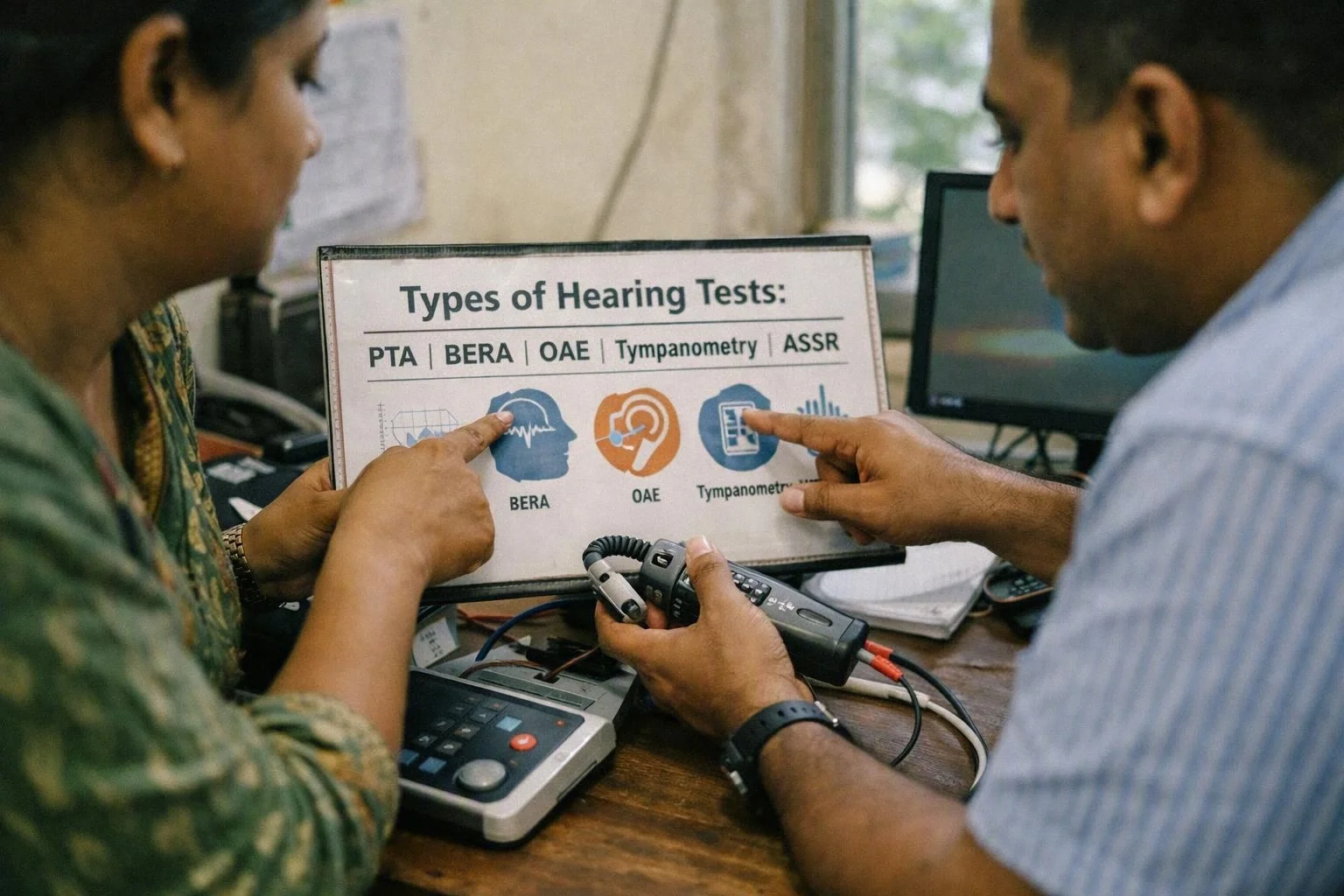
Hearing tests check hearing sensitivity, cochlear function, middle-ear health and nerve responses. The right combination depends on symptoms, age, communication skills and response quality.
Author: Dr. Sakti Prasad Mohanty
Which Hearing Test Do You Need?
Hearing tests check different parts of the auditory system. Pure Tone Audiometry measures hearing levels through responses to sounds. BERA checks auditory nerve and brainstem activity. OAE checks cochlear activity, and tympanometry checks middle-ear function. ASSR estimates hearing levels when responses are not reliable.
A hearing assessment usually starts with an ear examination and case history. An Audiologist may then use headphones or inserts for air conduction testing. This checks the full hearing pathway. Bone conduction testing sends vibrations through the skull. It helps show whether the problem affects the outer ear, middle ear or deeper hearing system.
Speech audiometry adds useful information about speech hearing and word understanding. PTA is often central for adults who can follow instructions. Babies, children with delayed speech and adults with unreliable responses may need objective tests instead.
Hearing Tests in Bhubaneswar, or elsewhere, may need more than one appointment. We match the test battery to each person. One result does not always provide a complete diagnosis.
Compare PTA, BERA, OAE, Tympanometry and ASSR
Pure Tone Audiometry measures responses to tones. BERA Testing records nerve activity, while Otoacoustic Emissions Testing checks inner-ear outer hair-cell function. Tympanometry checks eardrum and middle-ear movement. The ASSR Test estimates hearing levels across frequencies without reliable responses.
| Type | Key Features | Typical Cost | Best For |
|---|---|---|---|
| PTA | Responses to tones; produces an audiogram | Varies by provider and test battery | Co-operative older children and adults |
| BERA | Electrodes record auditory nerve and brainstem activity | Varies by clinical setting and preparation | Infants, neurological assessment and unreliable responses |
| OAE | Probe measures cochlear outer hair-cell echoes | Varies by screening or diagnostic use | Newborn screening and cochlear checks |
| Tympanometry | Measures eardrum movement and middle-ear pressure | Often included in a broader assessment | Fluid, blockage, pressure or eardrum concerns |
| ASSR | Provides frequency-specific objective threshold estimates | Varies with number of frequencies tested | Severe-to-profound loss and difficult behavioural testing |
These tests answer different questions, so one test cannot always replace another. A hearing assessment may take 30 to 90 minutes. Young children may need extra time, natural sleep or repeat testing.
Pure Tone Audiometry: The Standard Hearing Threshold Test
Pure Tone Audiometry is the main behavioural hearing test. It finds the softest tones a person can hear at selected frequencies. The results appear on an audiogram.
During air conduction testing, tones play through headphones or insert earphones. The person presses a button, raises a hand or gives another agreed response. Bone conduction uses a small vibrator behind the ear. It bypasses the outer and middle ear. Comparing both pathways helps the Audiologist identify conductive, sensorineural or mixed hearing loss.
Speech audiometry may also check speech detection and word understanding. PTA works well for people who understand the instructions. Still, it depends on attention, co-operation and honest responses. Ear blockage, poor concentration, tinnitus or confusion can affect the result. A repeat or additional test may be needed before hearing aid fitting.
BERA Testing: Measuring Auditory Nerve and Brainstem Responses
BERA Testing, also called an auditory brainstem response assessment, measures electrical activity along the auditory nerve and brainstem.
Small electrodes are placed on the forehead and around the ears or scalp. Earphones deliver soft sounds, and the equipment records the nerve waves. The patient does not need to press a button or raise a hand. This makes BERA useful for babies, young children and people with unreliable responses.
BERA can estimate hearing sensitivity and check the timing of nerve responses. It may help when an auditory nerve disorder is suspected. It is also useful when standard testing is not possible. Movement, muscle activity and electrical interference can affect the recording. Babies often need natural sleep. Some children may need specialist sedation under medical supervision. BERA results are read with other test findings.
OAE Testing: Checking Cochlear Function
Otoacoustic Emissions Testing checks whether the cochlea produces faint sounds after stimulation. These sounds mainly reflect the outer hair cells in the inner ear.
A soft probe sits in the ear canal and plays clicks or tones. A healthy cochlea sends a measurable echo back to the probe. The test is quick and painless. It also needs no active response, so it is widely used for newborn screening.
OAE results can show that cochlear activity is present. They do not give a complete hearing level at every frequency. Earwax, fluid, noise, movement or a poor probe seal can affect the result. An absent response does not prove permanent hearing loss. The ear may need checking before the test is repeated. BERA or ASSR may follow when needed. OAE can also monitor cochlear function with other hearing tests.
Tympanometry: Assessing the Middle Ear
Tympanometry checks how the eardrum and middle ear respond to air pressure changes. It produces a graph called a tympanogram.
A probe gently seals the ear canal and changes the pressure. It also plays a tone. The equipment records eardrum movement and estimates middle-ear pressure. These findings can help detect fluid, a perforation, stiff movement or Eustachian tube problems.
Tympanometry does not measure hearing sensitivity by itself. Earwax, a loose probe seal or an ear infection can affect the tracing. It is often combined with PTA, OAE or speech testing. Medical review or another assessment may be advised when results do not match symptoms.
ASSR Test: Estimating Hearing Levels Without Reliable Responses
ASSR Test uses an auditory steady-state response to estimate hearing levels at different frequencies. It is helpful when a person cannot respond reliably to tones.
Earphones play changing sounds while electrodes measure the brain’s electrical response. The system checks activity at several frequencies. It can support hearing-aid selection.hearing rehabilitation. ASSR may suit infants, children with limited attention and people with severe-to-profound hearing loss.
ASSR findings are estimates, not a direct behavioural audiogram. Movement, noise, sleep quality and equipment settings can affect accuracy. Results should be compared with OAE, BERA, tympanometry and clinical observations. Natural sleep may be enough for some children. Others may need a medically supervised plan to limit movement.
How Audiologists Choose the Right Hearing Test?
Audiologists choose hearing tests based on age, symptoms, medical history, communication skills and response reliability. A full assessment may combine PTA with tympanometry, OAE, BERA or ASSR. This helps identify conductive, sensorineural and mixed hearing loss before treatment or hearing rehabilitation.
Reduced air conduction with better bone conduction may suggest conductive hearing loss. Similar reductions in both pathways may suggest sensorineural loss. Combined results help prevent temporary ear problems from being mistaken for permanent loss.
What to Expect Before, During and After Testing?
Hearing test preparation depends on the test method. PTA may need a quiet room, clean ears and careful attention. Young children may need natural sleep for OAE, BERA or ASSR. The Audiologist reads results alongside symptoms and examination findings.
Most simple appointments take about 30 to 90 minutes. Newborn and paediatric assessments may take longer. Bring previous reports and hearing devices when requested. They can help the team track changes over time.
Questions About Hearing Aid Clinic
What Are the Different Types of Hearing Tests?
The main types include Pure Tone Audiometry, BERA, Otoacoustic Emissions Testing, tympanometry and ASSR. PTA measures hearing thresholds, BERA records nerve and brainstem activity, and OAE checks cochlear function. Tympanometry assesses middle-ear movement, while ASSR estimates frequency-specific thresholds.
Which Hearing Test Is Best for Adults?
PTA is the main test for most adults who can follow instructions. It measures hearing levels across frequencies. Tympanometry and speech audiometry are often added. BERA or ASSR may help when responses are unreliable or objective information is needed.
What Is the Difference Between PTA and BERA?
PTA needs a conscious response when a person hears a tone, so it is behavioural. BERA uses electrodes to record auditory nerve and brainstem responses. The person does not need to respond actively. Both tests provide different but useful information.
Are OAE and BERA Tests Painful?
OAE and BERA are generally painless. OAE uses a small probe in the ear canal. BERA uses surface electrodes and earphones or inserts. Some children may dislike the equipment or need to remain still, but the tests should not cause pain.
Which Hearing Test Is Used for Babies and Young Children?
OAE is commonly used for newborn hearing screening. If results are unclear or hearing loss is suspected, BERA or ASSR can provide objective estimates. These tests are often done while the baby sleeps naturally. Older children may complete play-based PTA when they can respond reliably.
Discuss the results with an Audiologist before choosing monitoring, medical care or hearing aid fitting. A tailored assessment can show which part of the auditory system needs attention.
Enquire about an assessmentRelated Resources
Pediatric Hearing Clinic for Children
Who It's ForNewborn Hearing Testing for Infants
newborn hearing testing clinic for infants
Who It's ForHearing Aid Clinic for People with Tinnitus
hearing aid clinic for tinnitus
Who It's ForHearing Aid Clinic for Cochlear Implant Candidates
hearing aid clinic for cochlear implant evaluation