What is a Decibel?
Decibel is a logarithmic unit used to express the ratio between two levels of sound intensity, sound pressure, or signal power. In hearing care, decibels describe sound level and hearing thresholds. The abbreviation is dB, and the reference value changes with the measurement system, such as dB SPL or dB HL.
Quick Facts About Decibel
Category
Sound and hearing measurement unit
Abbreviation
dB
Used for
Sound levels, hearing thresholds, and signal strength
Common confusion
dB SPL and dB HL use different reference scales
Also called
dB, Decibels
Often discussed with
Pure Tone Audiometry, Hearing Aid Programming
Key Takeaways About Decibel
- Decibel is a logarithmic unit, so equal increases represent larger physical changes in sound energy.
- Audiograms commonly use dB HL to show how softly you can hear different test tones.
- Sound level and hearing level use different reference scales. So their numbers are not interchangeable.
- Long exposure to loud sound can increase the risk of noise-induced hearing loss.
- A negative hearing threshold value can indicate better-than-reference sensitivity, not hearing damage.
Understanding Decibel
Decibelis a logarithmic unit that compares one level with a reference level. Sound professionals use it to describe pressure, intensity, or electrical signal strength. The abbreviation.dB, and the value doesn't describe an absolute amount unless the reference scale is also stated.
Related glossary terms: Audiogram, Hearing Threshold, Noise-Induced Hearing Loss.
Human hearing covers a very wide range of sound pressures. So a logarithmic scale is more practical than ordinary units. A change of 10 dB represents a tenfold change in sound intensity, although people may not experience every 10 dB change in the same way. The perceived loudness of a sound also depends on frequency, duration, distance, and the listener's hearing ability.
How Decibel Works, Is Measured, or Is Used?
Decibel values come from a ratio expressed on a logarithmic scale. For sound pressure level, the calculation uses 20 times the base-10 logarithm of the measured pressure divided by a reference pressure. Sound measurement equipment reports dB SPLwhich uses a standard reference pressure and helps describe the physical level reaching the ear.
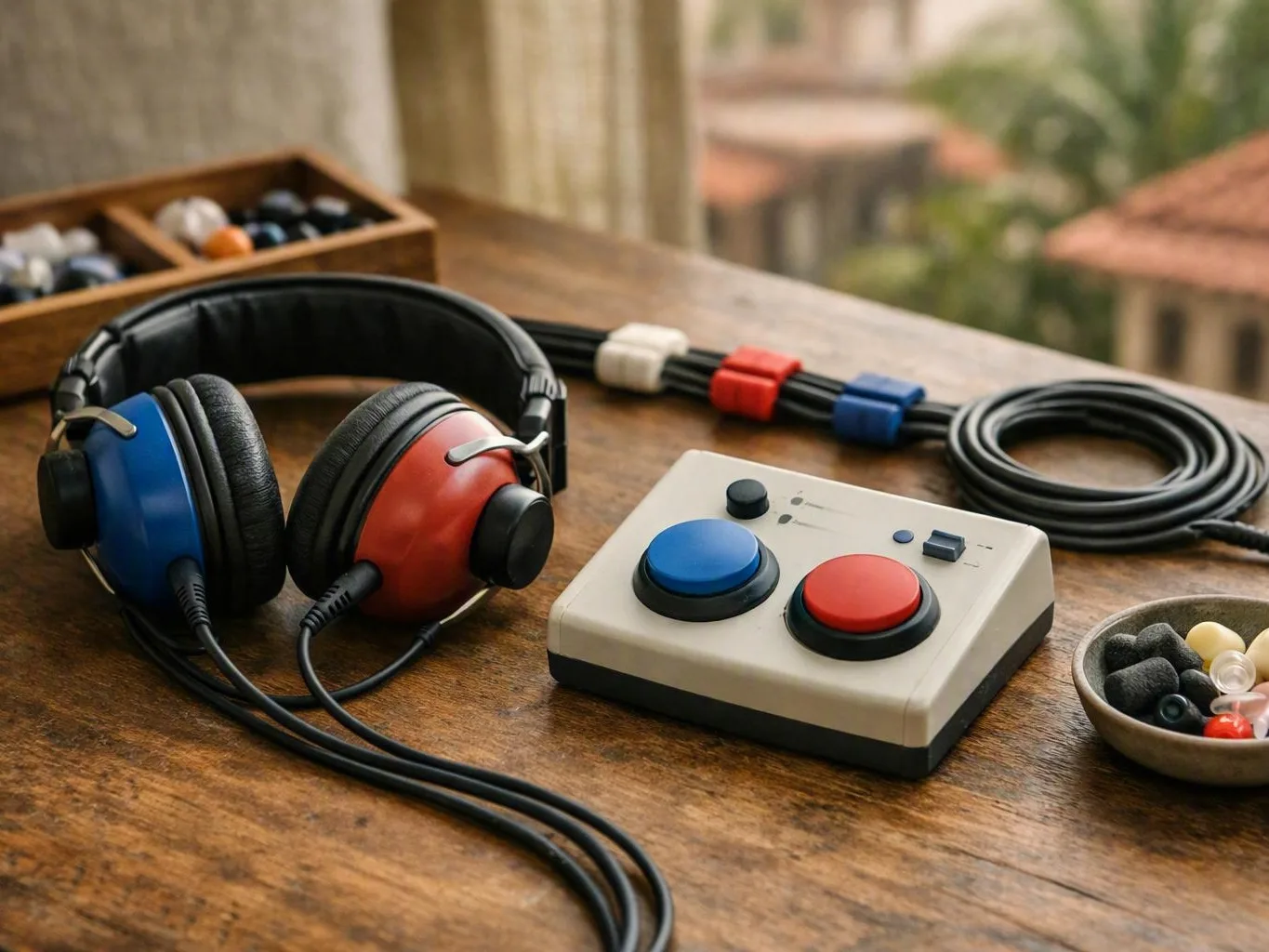
Hearing tests usually report thresholds in dB HL, or hearing level. This scale adjusts for the typical hearing sensitivity of people with normal hearing at each test frequency. During Pure Tone Audiometry, the audiologist presents tones at selected frequencies. They reduce or increase the level until the softest reliably heard sound is identified. The results appear on an audiogram, where higher threshold values generally indicate greater hearing loss.
Other scales answer different questions. dB A, written as dBA, applies frequency weighting that broadly reflects human hearing at moderate levels and is common in environmental noise measurements. dB C, written as dBC, gives greater weight to low-frequency sound and may help describe loud peaks. A dB value should therefore be interpreted with its scale, frequency, measurement position, and time pattern.
Why Decibel Matters?

Decibel readings help separate a physical sound problem from a hearing sensitivity problem. A noise survey may show how loud a workplace or device is, while an audiogram shows the level needed for a person to detect tones. These measurements support decisions about hearing protection, communication needs, and hearing aid settings.
The number alone doesn't predict how well someone understands speech. Speech Perception can be affected by frequency-specific loss, background noise, tinnitus, language, attention, and distortion in the inner ear. Two people with similar pure-tone thresholds may therefore report different listening difficulties. Clinicians combine decibel results with case history, speech testing, and ear examination.
When Decibel Matters Most?
Decibel becomes especially useful when you assess possible Noise-Induced Hearing Loss, compare test results, or set safe listening practices. Repeated exposure to loud music, machinery, traffic, or amplified sound can place stress on the hearing system. Risk depends on both level and duration, so a brief peak and a long lower-level exposure shouldn't be judged by the same number alone.
Decibel information also matters during Hearing Aid Fitting and Hearing Aid Programming. The audiologist matches amplification to the measured hearing thresholds, speech needs, comfort, and listening environments. A hearing aid doesn't simply make every sound louder, because excessive amplification can reduce comfort and may worsen feedback. Follow-up measurements and real-world reports help refine the settings safely.
How to Evaluate Decibel?
- Check whether the reading states its scale, such as dB SPL, dB HL, dBA, or dBC.
- Confirm the test frequency, measurement distance, equipment calibration, and test environment.
- Compare audiogram thresholds across both ears and across frequencies, not only one average number.
- Ask whether speech perception results match the reported difficulty in quiet and noisy situations.
- For loud environments, assess both sound level and daily exposure duration before choosing protection.
Related Concepts Compared
Decibel vs. dB SPL
dB SPL describes physical sound pressure against a fixed reference. It is commonly used for environmental sound, loudspeaker output, and equipment testing.
Decibel vs. dB HL
dB HL is an audiological scale that compares hearing thresholds with normal reference values at each frequency. It is not interchangeable with dB SPL.
Decibel vs. Loudness
Loudness is the listener's perception of sound strength. Decibel is a measurement expression, while loudness can vary between people and listening conditions.
Decibel vs. Hertz
Hertz measures frequency, or cycles per second. Decibel measures level, so frequency and level describe different properties of sound.
Expert Note
A decibel value should never be interpreted without its reference scale and frequency. In audiology, a threshold in dB HL is meaningful because it is calibrated for the test frequency, transducer, and testing method.
Common Mistakes or Myths About Decibel
- Treating every dB number as if it uses the same reference scale.
- Assuming a 10 dB increase means only a small physical change.
- Using an audiogram threshold to estimate environmental noise directly.
- Judging hearing ability from one frequency without reviewing the full audiogram.
- Ignoring exposure duration when assessing noise risk.
Decibel in Practice: A Real-World Example
A person may hear a 1000 Hz tone at 25 dB HL in the right ear and 45 dB HL in the left ear. The higher left-ear threshold means that the tone must be presented at a stronger level for reliable detection. Speech testing may still be needed to assess everyday understanding.
Sources & Further Reading on Decibel
Related Services
Related Terms
Audiogram
Audiogram is a graph that records a person’s hearing thresholds across different pitches and loudness levels…
Hearing Threshold
Hearing Threshold is the quietest sound a person can detect at a specific frequency under defined…
Noise-Induced Hearing Loss
Noise-Induced Hearing Loss is permanent or temporary damage to hearing caused by loud sound or repeated…
Speech Perception
Speech Perception is the brain’s ability to detect, recognise, and understand spoken language from sound signals…
Audium Hearing Aid Clinic
Have Questions About Decibel?
Contact Audium Hearing Aid Clinic for practical guidance on Decibel and related hearing aid clinic work in Bhubaneswar.