What is a dB?
dB is the abbreviation for decibel, a logarithmic unit used to express the ratio between two levels of sound or other physical quantities. In hearing care, dB commonly describes sound intensity, hearing thresholds, hearing aid output, and noise exposure. The meaning depends on the reference scale, such as dB SPL or dB HL.
Quick Facts About dB
Category
Logarithmic measurement unit
Formula
10 log10 of a power ratio, or 20 log10 of an amplitude ratio
Used for
Sound level, hearing thresholds, hearing aid output, and noise exposure
Common confusion
dB, dB SPL, and dB HL are not interchangeable
Also called
decibel, decibels
Often discussed with
Pure Tone Audiometry, Hearing Aid Programming
Key Takeaways About dB
- dB is a ratio, so its meaning depends on the reference scale being used.
- dB SPL describes physical sound pressure, while dB HL describes hearing test results.
- A higher dB HL value usually indicates a greater hearing threshold and more hearing difficulty.
- Hearing aid settings require dB levels alongside frequency, compression, and other measures.
- Noise risk depends on both sound level and the length of exposure.
Understanding dB
dB means decibel, a logarithmic way to describe the relationship between two levels. Sound measurements use a reference value, so the same number can mean different things on different scales. For example, dB SPL describes the physical pressure of sound in air, while dB HL describes hearing thresholds compared with average normal hearing.
Related glossary terms: Decibel, Audiogram, Hearing Threshold.
The scale is logarithmic rather than linear. A change of 10 dB represents a tenfold change in sound intensity, although people don't hear loudness in a perfectly direct way. The result also depends on frequency, because the human ear responds differently to low and high tones. A dB value therefore needs its scale and frequency before it can be interpreted correctly.
How dB Works, Is Measured, or Is Used?
Sound equipment measures pressure changes and converts them into a decibel value against a reference. The basic power relationship uses 10 times the base-10 logarithm of a ratio. Measurements based on pressure or voltage use 20 times the base-10 logarithm of a ratio. This calculation allows very small and very large sound levels to fit on a practical scale.
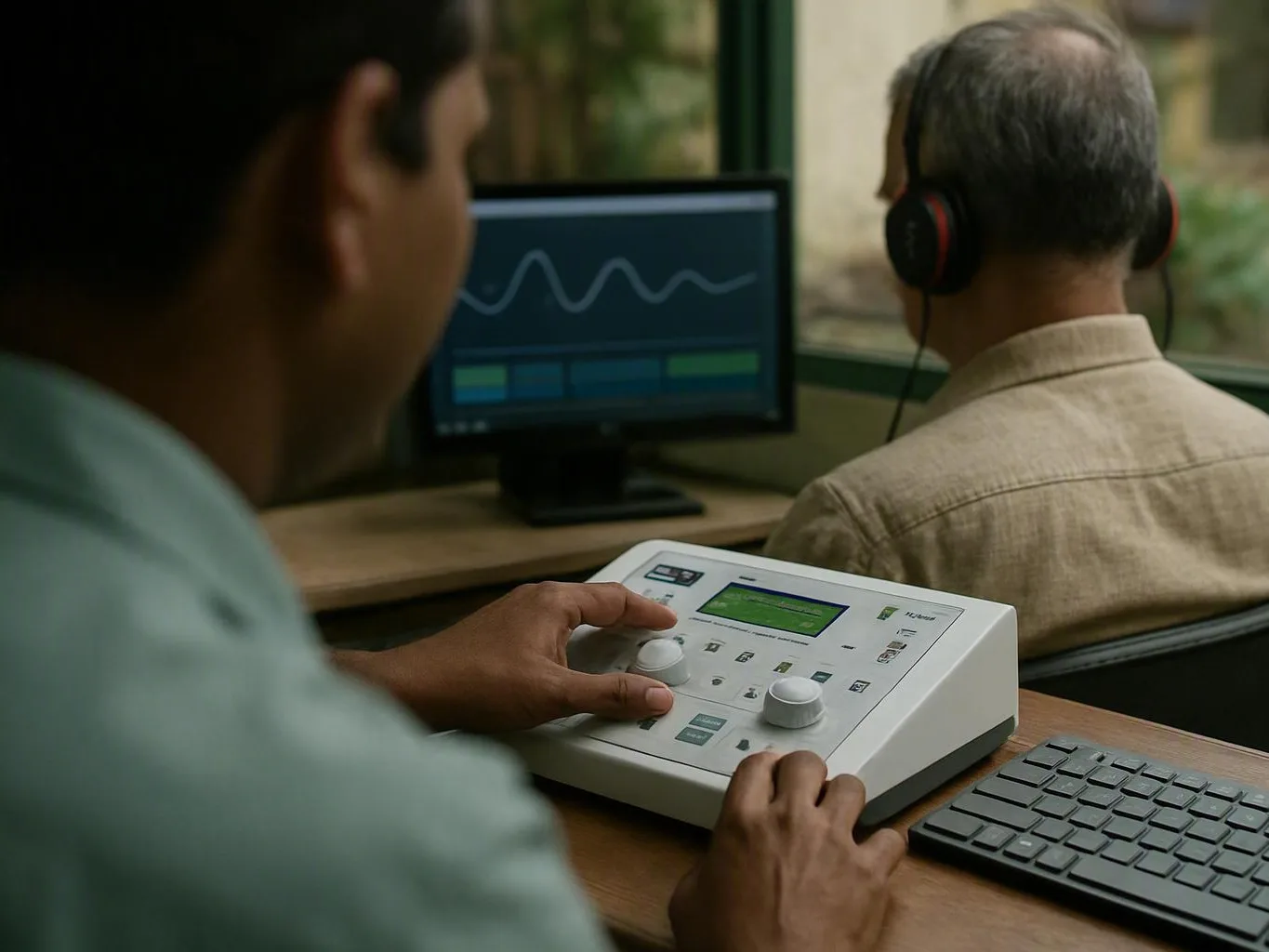
During pure tone audiometryan audiologist presents tones at selected frequencies and records the quietest level you can detect. The result appears.audiogram, usually in dB HL. A threshold near 0 dB HL doesn't mean silence. It represents the average reference threshold for people with typical hearing at that frequency. Hearing aid programming uses these thresholds together with speech results and the device's electroacoustic limits.
Why dB Matters?
dB gives clinicians and engineers a shared language for comparing sound levels and hearing sensitivity. It helps show whether a tone is audible, whether a hearing loss is mild or more severe, and whether a device provides an appropriate amount of amplification. The number alone is not enough, because speech understanding may differ between two people with similar thresholds.
The reference scale also affects safety decisions. A workplace noise reading.dB(A) uses frequency weighting. This weighting broadly reflects human hearing, while a hearing test commonly uses dB HL. Confusing these scales can lead to incorrect conclusions about noise exposure, hearing loss, or hearing aid output. Correct interpretation supports safer listening and more accurate clinical decisions.
When dB Matters Most?
dB becomes especially useful during a hearing assessment, when the clinician compares thresholds across frequencies and between the two ears. It also matters during hearing aid fitting, because gain must match hearing needs without producing uncomfortable or unsafe output. Speech perception, loudness comfort, and real-ear measurements can add information that a threshold chart can't provide alone.
Noise exposure is another important setting. A high sound level may cause harm after a short exposure, while a lower level may become risky after many hours. People who work near machinery, attend loud events, or use personal audio devices may face noise risks. Those who notice discomfort from ordinary sounds should also consider the measured dB level and exposure duration. In Bhubaneswar, Odisha, clinics may use these principles while interpreting tests and adjusting hearing devices for daily listening environments.
How to Evaluate dB?
- Check whether the measurement states dB SPL, dB HL, dB(A), or another reference scale.
- Review the frequency in hertz because the same dB value can affect hearing differently at different frequencies.
- Compare hearing thresholds for each ear across the audiogram rather than relying on one overall dB number.
- Ask whether the reading represents a threshold, an average level, a peak level, or hearing aid output.
- For noise exposure, record both the sound level and the length of time spent in that environment.
Related Concepts Compared
dB vs. Decibel
Decibel is the full word for dB. The abbreviation and the full term refer to the same logarithmic unit.
dB vs. dB SPL
dB SPL measures physical sound pressure against a fixed reference pressure. It is not the same as dB HL, which is used for hearing thresholds.
dB vs. dB HL
dB HL expresses hearing test thresholds relative to an audiometric reference. A value in dB HL cannot be treated as a direct measurement of sound pressure.
dB vs. Loudness
Loudness is a person's perception of sound strength. dB is a measurement scale, and equal dB changes do not always produce equal changes in perceived loudness.
Expert Note
A dB value should never be interpreted without its reference scale, frequency, and measurement setting. In clinical practice, two people with the same dB HL threshold may have different speech understanding, loudness tolerance, or communication needs.
Common Mistakes or Myths About dB
- Treating dB as a fixed amount of loudness rather than a value based on a reference.
- Assuming dB HL and dB SPL describe the same measurement.
- Reading one audiogram number without checking the frequency and the other ear.
- Believing that a 10 dB change always sounds exactly twice as loud.
- Judging hearing aid benefit from gain in dB alone without considering speech understanding and comfort.
dB in Practice: A Real-World Example
An audiogram may show a hearing threshold of 45 dB HL at 2,000 Hz in one ear. That number means the tone had to be presented at a higher level than the reference threshold for the person to detect it. It does not mean the everyday environment contained 45 dB SPL.
Sources & Further Reading on dB
Related Services
Related Terms
Decibel
Decibel is a logarithmic unit used to express the ratio between two levels of sound intensity…
Audiogram
Audiogram is a graph that records a person’s hearing thresholds across different pitches and loudness levels…
Hearing Threshold
Hearing Threshold is the quietest sound a person can detect at a specific frequency under defined…
Speech Perception
Speech Perception is the brain’s ability to detect, recognise, and understand spoken language from sound signals…
Audium Hearing Aid Clinic
Have Questions About dB?
Contact Audium Hearing Aid Clinic for practical guidance on dB and related hearing aid clinic work in Bhubaneswar.