When Does a Newborn Hearing Test Need BERA Testing?
Newborn hearing screening finds babies who may need more testing. BERA testing checks hearing responses when screening is not passed, results are unclear, or risk factors exist. It also helps when behavioural testing cannot give reliable results. A paediatric audiologist or ENT specialist chooses the next test after reviewing the baby’s history and examination. At Audium Hearing Aid Clinic, we explain each step clearly. We also explain how Newborn Hearing Testing in Bhubaneswar may move from screening to diagnostic review.
Author: Dr. Sakti Prasad Mohanty
Why Newborn Hearing Screening Comes First?
Newborn hearing screeningis the first check for possible hearing loss. It is quick, painless, and suitable for babies. Hospitals often complete it before discharge or during an early follow-up visit. Screening does not give a full diagnosis.
The main aim is to find babies who may not hear sounds clearly. Early support can protect speech and language development. Families also get time to understand the result and arrange a full hearing evaluation.
Common screening methods include otoacoustic emissions (OAE). OAE measures tiny responses from the cochlea after sound enters the ear. Another method is automated auditory brainstem response (AABR). AABR checks whether sound creates a measurable response along the hearing pathway. Both methods suit newborns and usually take little time.
A screen can be affected by a restless baby, background noise, or a poor probe seal. Temporary ear blockage may also affect the result. So, screening is a starting point, not a final diagnosis. Our team reviews the result with the baby’s history. We then advise whether repeat screening or diagnostic BERA is suitable.
What Does a Refer Result Mean?
A refer result means the newborn hearing screen did not record a clear response in one or both ears. It does not confirm permanent hearing loss. Vernix, movement, noise, or middle-ear fluid can affect screening. The clinician may repeat the screen or arrange diagnostic testing.
A pass result means the equipment found responses within its screening limits at that time. It does not check every part of hearing. It also cannot guarantee that hearing will stay unchanged. A refer result means the test needs checking. It does not mean that the baby definitely has hearing loss.
Vernix can block the ear canal and stop the probe from working well. Middle-ear fluid may remain after birth and reduce sound reaching the cochlea. Crying, sucking, muscle activity, and movement can also affect the recording.
When suitable, repeat screening takes place in a quiet setting. This may happen after temporary problems have settled. If the result remains unclear, the audiologist may suggest diagnostic BERA. This is more likely when the baby has known risk factors.
How BERA Testing Measures Infant Hearing?
BERA testing is also called an auditory brainstem response test. It records activity from the auditory nerve and brainstem after controlled sounds reach the ears. It helps when a baby cannot respond reliably by turning towards sound.
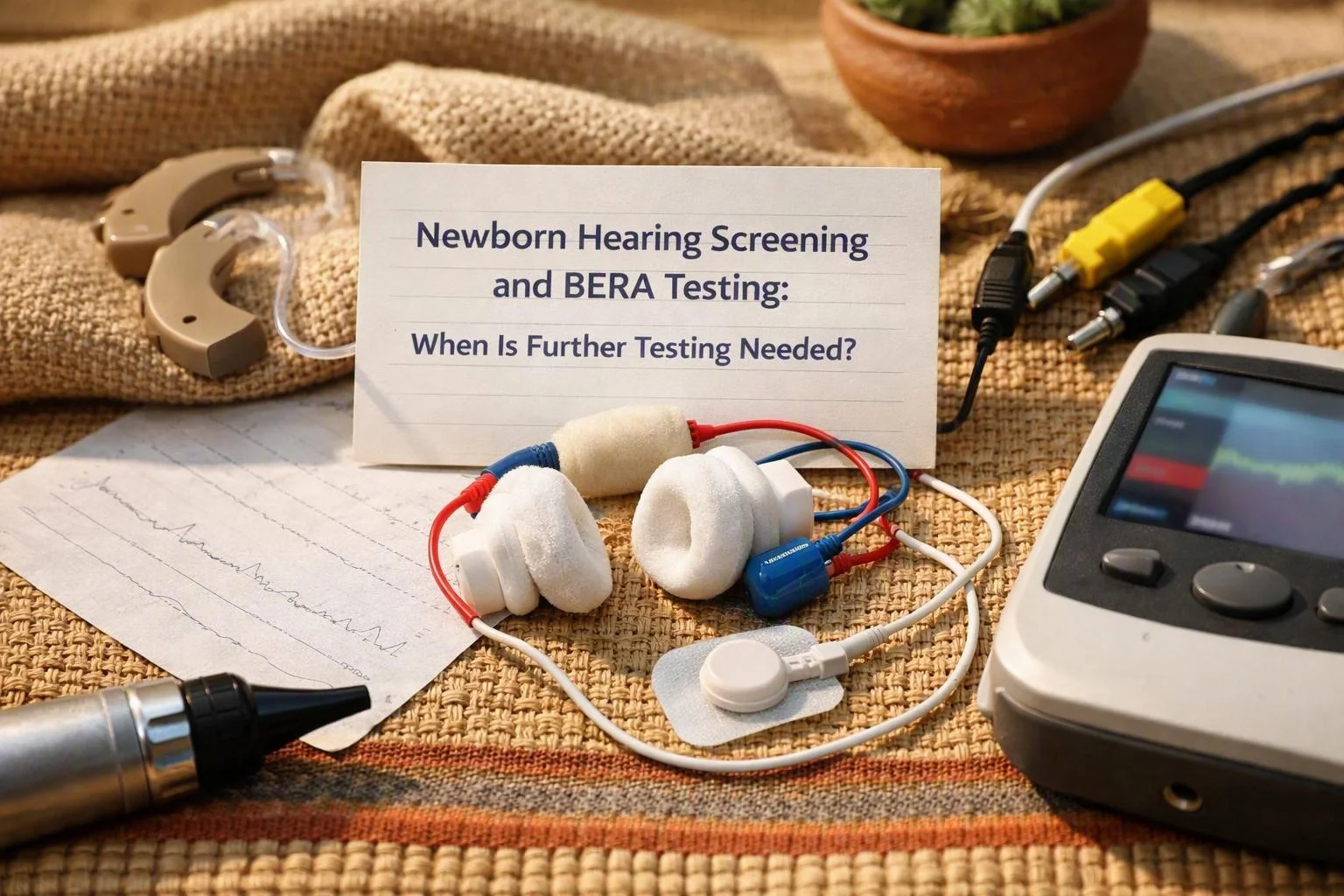
During the BERA test, small electrodes are placed on prepared areas of the forehead and scalp. Soft earphones or inserts send clicks or tones to each ear. The equipment records the body’s hearing response. The audiologist then studies the wave patterns.
The clinician changes the sound level to estimate a hearing threshold. This is different from a standard adult hearing test. Still, it shows whether the hearing pathway responds within an expected range. Results may suggest normal responses, a conductive issue, sensorineural hearing loss, or a need for more testing.
Good results depend on quiet sleep and steady recording conditions. The electrodes must touch the skin properly, and the earphones must fit well. Low electrical noise also helps. Middle-ear fluid can change the response. So, the audiologist considers the ear examination and other hearing results too.
When Is Further Testing Needed After a Newborn Hearing Test?
Further testing is needed after a newborn hearing test when the baby has repeated refer results. It may also be needed when risk factors exist, screening responses vary, or behavioural testing is unreliable. Diagnostic BERA helps estimate hearing sensitivity. It can support timely medical review, hearing technology, and early intervention.
A failed newborn hearing screen in one or both ears needs follow-up. The next step may be another screen, an ear examination, or tympanometry. Diagnostic BERA may also be advised. The choice depends on the baby’s age, health, test quality, and result for each ear.
Risk factors can include a family history of childhood hearing loss. They may also include congenital infections, craniofacial differences, or severe jaundice needing treatment. Exposure to ototoxic medicines and a long neonatal intensive care stay are other factors. These risks do not prove hearing loss. However, they may require closer monitoring after a pass result.
Behavioural responses are often unreliable in very young babies. Sleep, feeding, attention, and development can change quickly. Objective testing can therefore provide useful information. An audiology or ENT team reviews the BERA result with the examination. They may then suggest repeat testing, hearing-aid evaluation, specialist review, or early intervention.
When Are Newborn Hearing Screening and BERA Testing Used Together?
Newborn hearing screening and BERA testing are used together when screening raises concern. BERA then provides a more detailed, objective assessment. This may apply after repeated refer results, neonatal risk factors, or suspected hearing loss. It may also help when routine testing gives unreliable responses.
These tests create a clear care pathway. Screening checks many newborns quickly. Diagnostic testing looks more closely at the reason for concern. A result affecting one ear still matters. Unilateral hearing loss can affect listening in noise, classroom learning, and language development.
Our team explains what the findings may mean for everyday listening. We can also advise whether an ENT specialist or a Hearing Aid Clinic should review the baby. Early intervention does not always mean a device is needed. It means arranging suitable support without avoidable delay.
What Happens Before, During, and After a BERA Test?
BERA testing records responses from the infant’s auditory nerve and brainstem. Sounds are played through small earphones. The baby usually needs to sleep quietly, so movement does not affect the recording. The audiology team explains the preparation and discusses the follow-up plan.
BERA is generally painless. Babies may object while staff settle them or prepare the skin. Some may dislike wearing the earphones. The test does not give an electric shock. Parents should share concerns about illness, feeding, sleep, or medicines. This helps the team plan safely.
How Do Newborn Screening and BERA Testing Differ?
Newborn hearing screening and BERA testing have different purposes. Screening quickly finds babies who may need review. BERA is a diagnostic test that measures hearing pathway responses. It also helps estimate hearing thresholds. Screening does not replace BERA when concerns, risk factors, or unreliable responses remain.
The methods work together rather than compete. Otoacoustic emissions screening mainly checks cochlear responses. Auditory brainstem response testing follows sound activity along the auditory nerve and brainstem. The audiologist also considers ear health, test conditions, gestational age, and medical history.
| Aspect | Newborn hearing screening | BERA testing |
|---|---|---|
| Purpose | Identifies infants who may need further assessment | Provides objective diagnostic information about auditory responses |
| Typical methods | Otoacoustic emissions or automated auditory brainstem response | Auditory brainstem response recording with electrodes and earphones |
| Timing | Usually performed soon after birth or during early follow-up | Arranged after concerning screening, risk factors, or clinical recommendation |
| Result | Pass or refer | Estimated hearing sensitivity and recommendation for follow-up |
Screening is made for speed and wide access. Diagnostic BERA gives more detail when the first result needs clarification. A paediatric audiologist or ENT specialist decides whether the findings are enough. They may also advise another hearing evaluation.
Questions About Hearing Aid Clinic
When Does a Newborn Need a BERA Test?
A newborn may need BERA after repeated refer results, unclear screening, recognised risk factors, suspected hearing loss, or unreliable behavioural responses. The paediatric audiologist or ENT specialist reviews the full history and examination before choosing diagnostic testing.
What Happens if My Baby Fails the Newborn Hearing Screening?
A failed screen, usually called a refer result, does not confirm permanent hearing loss. Temporary blockage, middle-ear fluid, movement, or noise may affect the recording. The next step is usually repeat screening or a diagnostic hearing assessment, based on the clinical situation.
Is BERA Testing Painful for a Newborn?
BERA testing is generally painless. The baby hears soft sounds through earphones while small electrodes record responses from the skin. Some infants become unsettled during preparation or while being kept still. The recording itself should not cause pain.
How Long After a Failed Hearing Test Should BERA Be Done?
The timing depends on the repeat-screen result, the baby’s health, age, risk factors, and local clinical pathway. Parents should follow the appointment advised by their audiology or ENT team. They should not wait for behavioural responses to become reliable.
Can a Newborn Pass the Hearing Screening but Still Need BERA Testing?
Yes. A baby may pass screening but later need BERA because of risk factors, new concerns, delayed communication, or a clinical finding. Screening is not a complete lifelong hearing assessment. Planned monitoring remains important when concerns arise.
For questions about preparation, results, or follow-up, contact our team.
Get a Free EstimateRelated Resources
Pediatric Hearing Clinic for Children
Who It's ForNewborn Hearing Testing for Infants
newborn hearing testing clinic for infants
Who It's ForHearing Aid Clinic for Cochlear Implant Candidates
hearing aid clinic for cochlear implant evaluation
Everything About ItBERA vs ASSR Test: Differences, Accuracy, Preparation, Cost Factors and Who Needs Each
BERA vs ASSR test