
What is Acoustic Reflex?
Acoustic Reflex is an automatic contraction of the stapedius muscle in the middle ear after exposure to a sufficiently loud sound. The response reduces sound transmission through the ossicles and helps protect the inner ear. Audiologists measure this response during immittance testing to assess middle-ear function and parts of the auditory nerve pathway.
Quick Facts About Acoustic Reflex
Category
Middle-ear reflex response
Measured by
Immittance equipment
Used for
Auditory pathway assessment
Common confusion
Not the same as a hearing threshold
Also called
Stapedius reflex, Middle-ear muscle reflex
Often discussed with
Tympanometry, Hearing Loss Diagnosis
Key Takeaways About Acoustic Reflex
- A loud sound normally triggers the stapedius muscle to contract in each middle ear.
- Audiologists measure this response with immittance equipment during a hearing assessment.
- Absent or unusually strong responses can reflect middle-ear, nerve, or brain pathway problems.
- The test does not measure hearing sensitivity by itself and needs other results for interpretation.
Understanding Acoustic Reflex
Acoustic Reflex is an automatic response. The stapedius musclecontracts after a sufficiently loud sound reaches the ear. The contraction stiffens the middle-ear system and changes how sound moves through.ossicles. This response occurs without conscious effort. It usually affects both ears, although the pattern depends on which ear receives the sound.
Related glossary terms: Hearing Threshold, Audiogram, Ossicles.
The reflex forms part of the auditory pathway. It runs.eardrum and middle ear to the cochlea, auditory nerve, brainstem, and facial nerve. It's not a complete protective shield against loud noise, and it doesn't prevent all noise-related injury. Instead, it changes sound transmission and provides useful information about several parts of the hearing system.
How Acoustic Reflex Works, Is Measured, or Is Used?
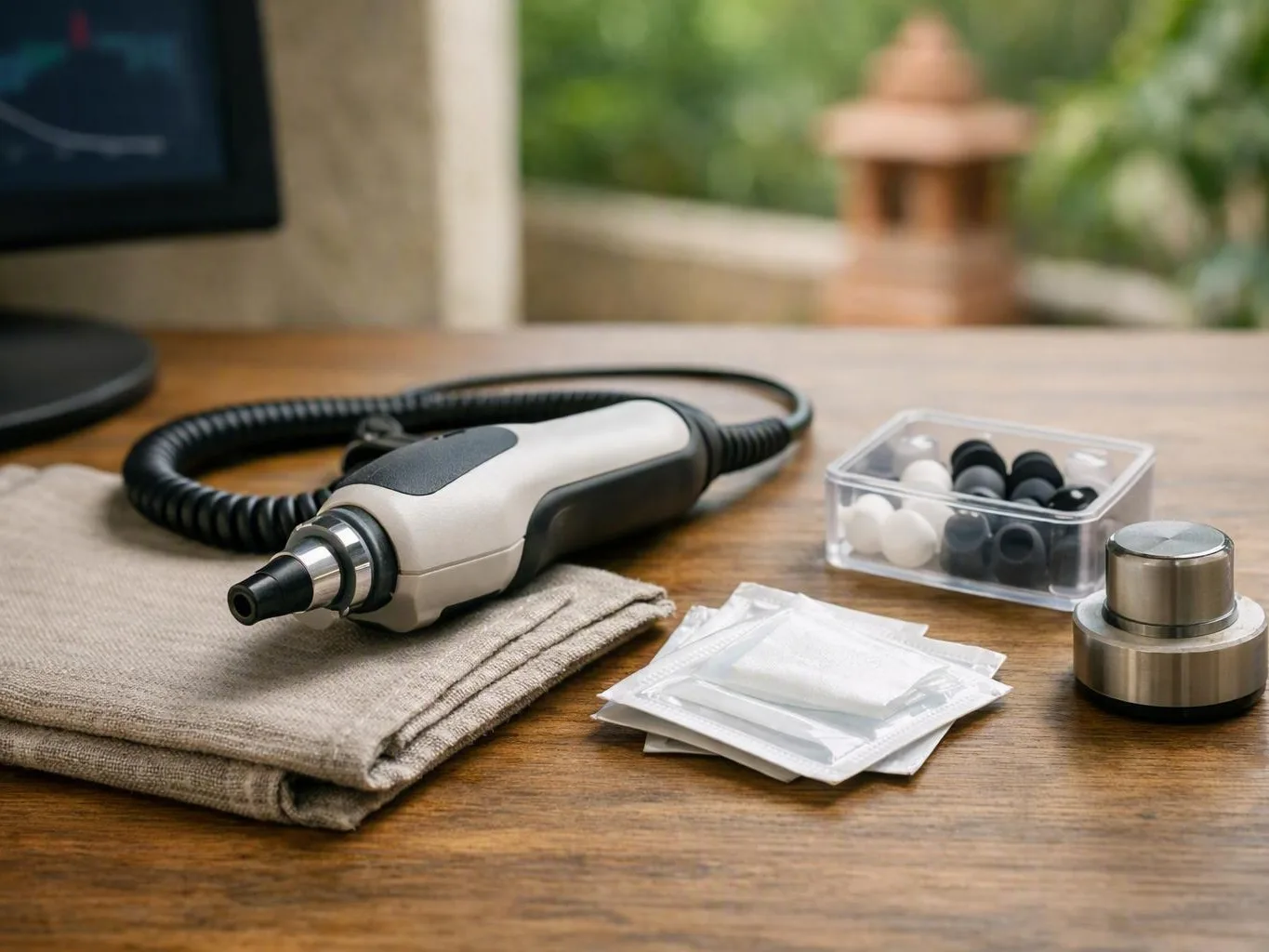
Acoustic Reflex testing usually forms part of immittance testing, often alongside tympanometry. A probe seals the ear canal and measures changes in acoustic immittance. The clinician presents tones through the probe or a separate earphone. The equipment records whether the middle-ear response appears, the sound level that triggers it, and the size and timing of the change.
The ear receiving the sound is called the stimulated ear. The ear being measured is called the probe ear. A test may measure an ipsilateral response, where stimulation and measurement occur in the same ear. It may measure a contralateral response, where they occur on opposite sides. Results are interpreted with the tympanogram, pure-tone thresholds, speech results, ear examination, and the person’s symptoms.
A response may be recorded as present, absent, elevated, or difficult to interpret. Fluid behind the eardrum, earwax, a perforated eardrum, or poor probe placement can affect the measurement. The clinician therefore checks the ear canal and middle-ear status before treating an unusual result as evidence of a nerve or brainstem disorder.
Why Acoustic Reflex Matters?
Acoustic Reflex findings can help separate a problem in the middle ear from one involving the auditory nerve or brainstem. For example, an absent response with an abnormal tympanogram may fit a conductive problem. An absent response with normal middle-ear movement may require a different interpretation. The result becomes more useful when it agrees with the wider assessment.
Clinicians may use the pattern to support hearing loss diagnosis and investigate facial nerve or retrocochlear concerns. They may also assess complex listening complaints. The test doesn't identify a condition on its own. A normal response also doesn't prove that hearing is normal, because some people with hearing loss still show measurable reflexes.
When Acoustic Reflex Matters Most?
Acoustic Reflex testing matters most when routine results don't fully explain a person’s hearing difficulty. It can add information in cases involving asymmetric hearing lossunclear speech understanding, suspected facial nerve weakness, or differences between pure-tone and speech findings. It may also help clinicians decide whether further diagnostic testing is warranted.
The test is usually brief. But the tones can feel loud. The clinician should explain the procedure, check for active ear problems, and avoid drawing conclusions from one measurement alone. In children, adults, and people with communication difficulties, reliable results depend on suitable equipment, accurate probe placement, and comparison with the complete hearing history.
How to Evaluate Acoustic Reflex?
- Check whether the result is reported as present, absent, elevated, or unreliable.
- Compare the reflex pattern with tympanometry and the condition of the ear canal.
- Review whether stimulation and measurement occurred in the same ear or opposite ears.
- Ask whether hearing thresholds, speech perception, symptoms, and ear history support the interpretation.
- Treat an unexpected result as one clinical finding, not a diagnosis by itself.
Related Concepts Compared
Acoustic Reflex vs. Tympanometry
Tympanometry measures eardrum and middle-ear movement as air pressure changes. Acoustic Reflex testing measures a muscle response after sound stimulation, although both tests often use the same probe system.
Acoustic Reflex vs. Hearing Threshold
A hearing threshold is the quietest sound a person detects at a specific frequency. An acoustic reflex is an automatic physiological response to a louder sound.
Acoustic Reflex vs. Stapedius Reflex
Stapedius reflex is another name for the muscle response commonly called the acoustic reflex. The terms usually describe the same middle-ear reaction.
Acoustic Reflex vs. Acoustic Reflex Decay
Acoustic reflex decay examines whether the reflex weakens during a sustained tone. Standard acoustic reflex testing mainly asks whether the response appears and at what level.
Expert Note
An absent reflex does not automatically indicate nerve damage. Middle-ear fluid, a blocked probe, a perforation, or severe conductive hearing loss can prevent a measurable response. Interpretation should begin with ear status and tympanometry before considering neural explanations.
Common Mistakes or Myths About Acoustic Reflex
- Assuming an absent reflex proves auditory nerve damage.
- Confusing an acoustic reflex level with the quietest sound a person can hear.
- Ignoring earwax, middle-ear fluid, perforation, or poor probe placement.
- Interpreting one reflex result without reviewing the complete hearing assessment.
Acoustic Reflex in Practice: A Real-World Example
A person has normal ear-canal findings but poorer hearing in one ear and reduced speech understanding. The audiologist records acoustic reflexes in both stimulation conditions and compares them with tympanometry and audiogram results. The pattern helps decide whether additional assessment of the auditory pathway is appropriate.
Sources & Further Reading on Acoustic Reflex
- National Institute on Deafness and Other Communication Disorders, How Do We Hear?
- American Speech-Language-Hearing Association, What Is an Audiologist?
- Merck Manual Professional Edition, Evaluation of Hearing Loss
Related Services
Related Terms
Hearing Threshold
Hearing Threshold is the quietest sound a person can detect at a specific frequency under defined…
Audiogram
Audiogram is a graph that records a person’s hearing thresholds across different pitches and loudness levels…
Ossicles
Ossicles are three tiny bones in the middle ear, called the malleus, incus, and stapes. These…
Cochlea
Cochlea is a spiral-shaped, fluid-filled organ in the inner ear that changes sound vibrations into electrical…
Audium Hearing Aid Clinic
Have Questions About Acoustic Reflex?
Contact Audium Hearing Aid Clinic for practical guidance on Acoustic Reflex and related hearing aid clinic work in Bhubaneswar.